.png)

.svg)
.svg)
.svg)
Anello intelligente vs fascia toracica: confronto sulla precisione dell’ECG
If you've ever trained seriously, you know the drill: wrap a plastic strap around your chest, wet the electrodes, and hope it doesn't chafe by mile five. Chest strap heart rate monitors like the Polar H10 have been the undisputed gold standard for decades. They deliver 99.6% accuracy against medical-grade ECG and are trusted by athletes and cardiologists alike.
Introduction: Two Worlds of Heart Monitoring
But they're uncomfortable. They're impossible to wear 24/7.
Enter the smart ring. Small, titanium, lives on your finger. The Circular Ring 2 is the first consumer smart ring with an ECG feature powered by an FDA-cleared algorithm. No chest strap required.
So the question is obvious: can a tiny ring on your finger really match a dedicated chest ECG monitor? The answer is nuanced, and it depends entirely on what you're measuring and why.
How Each Technology Works
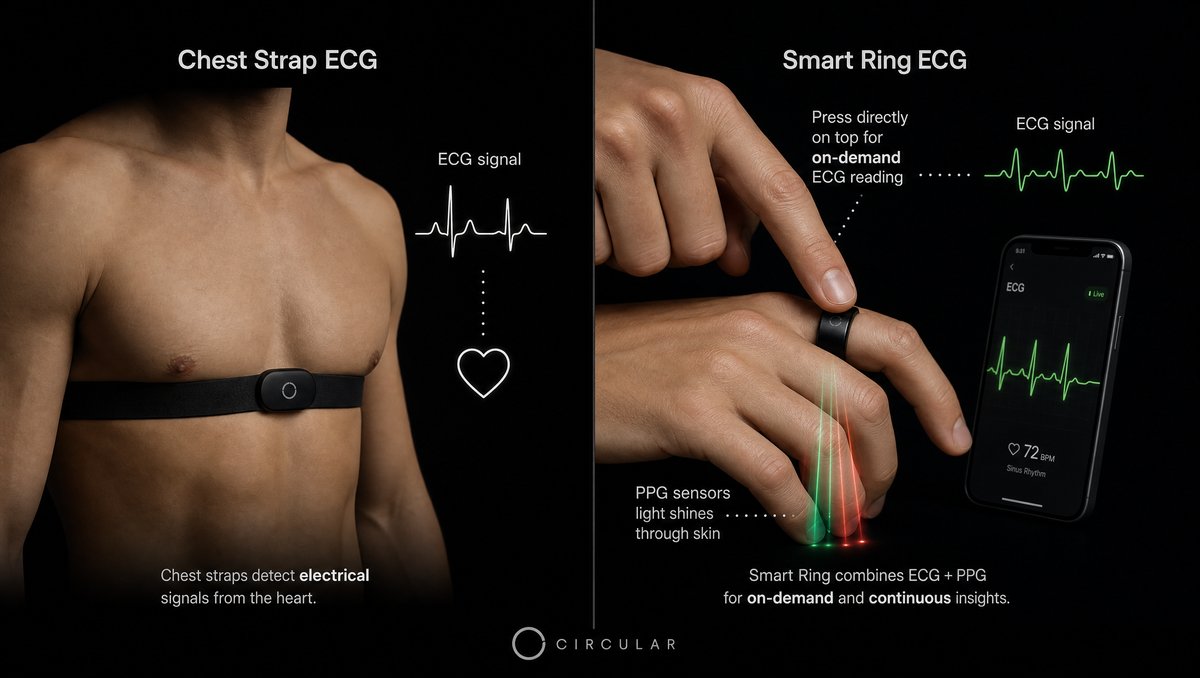
Chest Strap: Direct Electrical Sensing
A chest strap like the Polar H10 uses electrocardiography: it measures the electrical impulses that trigger each heartbeat, the same way a hospital ECG does. Because it sits directly on your chest, close to the heart, the signal is clean and nearly immune to motion artifacts. This is why chest straps achieve 99.6% correlation with clinical ECG, even during intense exercise.
Smart Ring: Photoplethysmography (PPG) + ECG Electrodes
Most smart rings rely on a single technology: PPG. Shining light through your skin to measure blood volume changes. This is the same optical tech in every smartwatch and fitness tracker, and it's inherently more sensitive to movement than electrical sensing.
The Circular Ring 2 is different. It is the only smart ring that combines PPG for continuous tracking with actual ECG electrodes on the ring's surface. You touch the ring with your opposite index finger for 45 seconds, and it records a clinical-quality single-lead ECG. This is the same principle as a chest strap (electrical, not optical), but from your finger instead of your chest.
Comparison: Smart Ring vs Chest Strap
The Accuracy Numbers
A 2025 systematic review published in Biomimetics (107 studies, ~100,000 participants) found the following at-rest accuracy:
- Smart ring heart rate accuracy: r² = 0.996 vs medical devices
- Smart ring HRV accuracy: r² = 0.980
- Sleep detection sensitivity: 93-96%
Source: Smart Ring in Clinical Medicine: A Systematic Review, Biomimetics, 2025.
For the Circular Ring specifically:
- The Circular Ring 2's ECG algorithm is FDA-cleared for AFib detection
- Independent testing by TechAdvisor confirmed ECG readings "looked accurate" and compared favorably to the Apple Watch ECG
Meanwhile, chest straps remain the benchmark:
- Polar H10: 99.6% correlation with medical ECG (validated in peer-reviewed studies)
- Garmin HRM-Pro Plus: similar accuracy, with running dynamics as a bonus
When the Chest Strap Still Wins
Chest straps are still superior for:
- High-intensity interval training (HIIT): Rapid heart rate changes during sprints, burpees, or box jumps confuse PPG sensors. Chest straps track every beat.
- Weightlifting: Gripping bars and kettlebells interferes with finger-based sensors.
- Swimming (competitive): While the Circular Ring 2 is IP68 water-resistant, chest straps paired with swim watches are the established solution for lap tracking.
- Medical-grade continuous monitoring: If a cardiologist needs beat-by-beat data for 24 hours, they prescribe a Holter monitor, which is essentially a multi-lead chest system.
When the Smart Ring Wins
The Circular Ring 2 isn't trying to replace a chest strap during a CrossFit WOD. It wins in the scenarios that matter for 95% of your life:
- 24/7 wearability: At 2 grams in titanium, you forget you're wearing it. You can't say that about a chest strap.
- Sleep tracking: Chest straps aren't designed for sleep. The ring tracks sleep stages, HRV, SpO₂, and temperature every night. Sleep quality is one of the strongest predictors of heart health.
- AFib screening: The ring's FDA-cleared ECG algorithm can detect atrial fibrillation, the leading cause of stroke, during a 45-second spot check. Early detection saves lives. You're far more likely to do a daily ring check than wear a chest strap to the office.
- Trend analysis: One ECG reading tells you what's happening now. Six months of nightly HRV, resting heart rate, and temperature data tells you what's changing. The Circular Ring 2 with Kira AI analyzes 140+ biomarkers daily.
- No subscription: Unlike competitors that lock ECG and advanced metrics behind monthly fees, Circular includes all 13+ features with no subscription.
The Circular Ring 2 is the only smart ring with 13+ premium health features, and zero subscription. Learn more
The Verdict: Complementary, Not Competitive
This isn't a zero-sum game. Think of it this way: a chest strap captures micro events, tracking every heartbeat during a 45-minute workout with surgical precision. A smart ring captures macro trends, building a picture of your health across weeks and months. Both matter, but they serve different purposes.
The chest strap is a surgical instrument: precise, specialized, and slightly uncomfortable. The smart ring is a health companion: always there, tracking trends, catching anomalies, and fitting into your life without friction.
For the serious athlete: wear a chest strap during training sessions, and a Circular Ring 2 the other 23 hours of the day.
For everyone else: unless you're doing HIIT workouts where beat-by-beat accuracy matters, the Circular Ring 2's combination of ECG with FDA-cleared algorithm, continuous health monitoring, and zero subscription makes it the pragmatic choice.
FAQ
Is the Circular Ring 2 ECG as accurate as a hospital ECG?
The Circular Ring 2 records a single-lead ECG. Hospitals use 12-lead systems. It's designed for screening, not diagnosis. The FDA clearance applies to the detection algorithm and confirms it meets clinical accuracy standards for its intended use. Think of it as an early warning system, not a replacement for your cardiologist.
Can I wear the Circular Ring 2 during a workout instead of a chest strap?
Yes. The ring uses PPG to track heart rate during 50+ sport modes and is IP68 water-resistant. But for HIIT, weightlifting, or any activity involving rapid arm movements, a chest strap will always be more responsive to sudden heart rate changes.
Does the Circular Ring 2 track heart rate continuously?
Yes, it monitors heart rate throughout the day using PPG. The on-demand ECG is a separate, more precise 45-second measurement you initiate manually.
Why is a chest strap still more accurate than any ring or watch?
Because it uses direct electrical sensing (ECG) on the chest, millimeters from the heart. Rings and watches primarily use optical PPG sensors on extremities, which are subject to motion artifacts, skin tone variation, and blood flow changes in cold weather. The Circular Ring 2 bridges this gap by adding actual ECG electrodes, but only for spot checks, not continuous ECG.
Do I need a subscription to use the ECG feature?
No. All 13+ health features on the Circular Ring 2, including unlimited ECG recordings, are included with no monthly subscription.
Quale dispositivo per il monitoraggio della salute si adatta meglio al tuo stile di vita?
Anello intelligente o fascia toracica: la scelta giusta dipende dalle tue priorità.
- You want all-day comfort? The 2g Circular Ring 2 is worn day and night, including for sleep. A chest strap cannot do that.
- Vuoi individuare anomalie cardiache come la fibrillazione atriale? Il Circular Ring 2 è l'unico anello smart dotato di un algoritmo ECG approvato dalla FDA per il rilevamento della fibrillazione atriale.
- Non vuoi pagare abbonamenti mensili? Circular Ring 2 include oltre 13 funzioni premium per la salute, senza abbonamento. Paghi una volta sola e lo usi per sempre.
Fai il quiz: scopri a che punto sei
References
- Gong EJ et al., "Smart Ring in Clinical Medicine: A Systematic Review," Biomimetics, 2025.
- Sawh M., "Circular Ring 2 Review," TechAdvisor, Editors' Choice.
- Polar H10 Scientific Review: 99.6% Accurate (peer-reviewed validation studies)
- Android Central: "I'm done with heart rate monitor chest straps" (2025)